
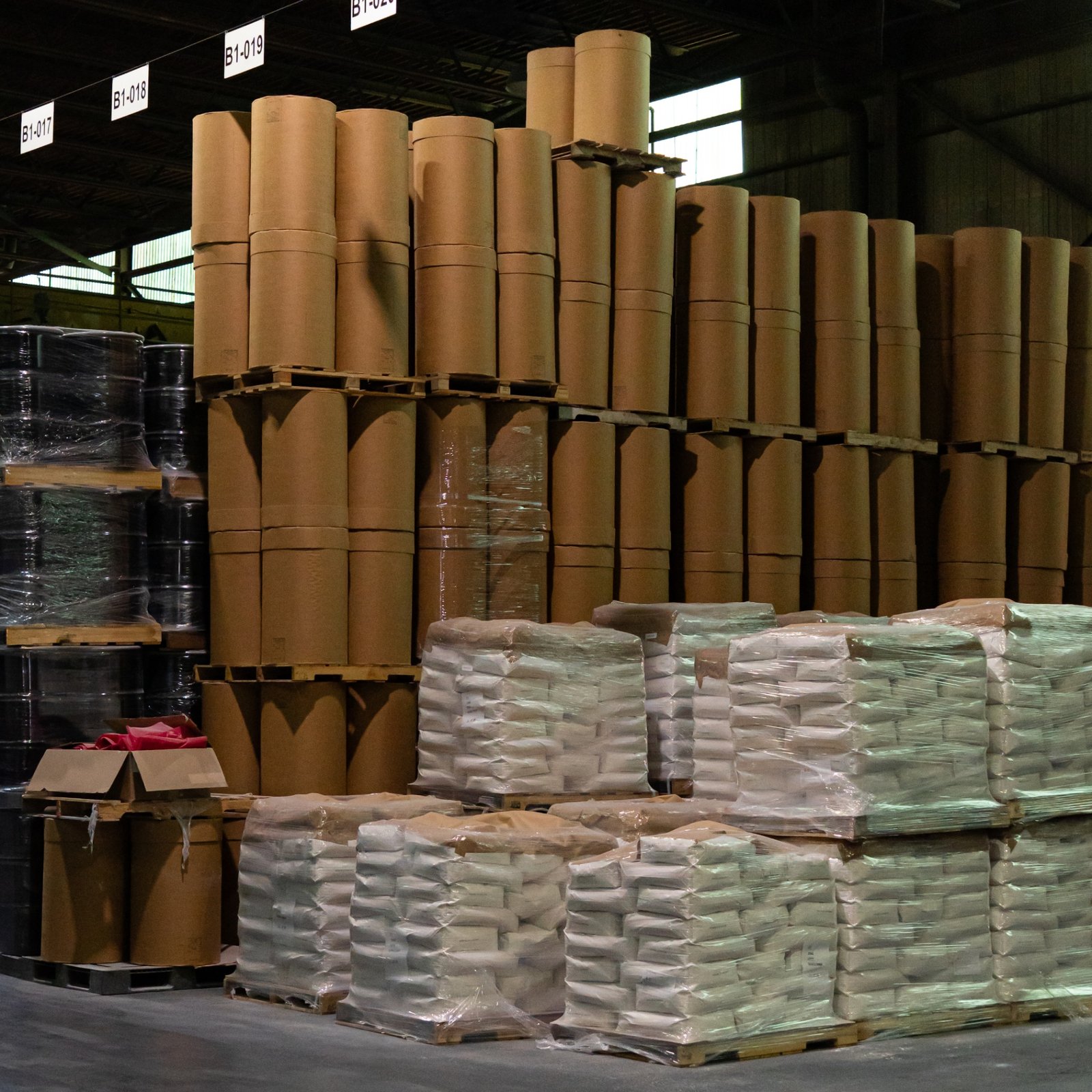
Picking packaging is a product decision
Chemical packaging gets treated as an afterthought, chosen by habit or whatever the last supplier used. It deserves more thought than that. The package decides what a customer can actually handle on their floor, how much freight you pay per pound, how well the product survives storage, and whether a moisture-sensitive or regulated material arrives the way it left. Here is how the common options compare for industrial chemicals, with most of the focus on dry powders and granules.
Bags: 25 to 55 pounds
Multiwall paper and woven or film polyethylene bags are the workhorse of dry chemical packaging. The usual sizes are 50 lb and 25 kg (about 55 lb), with smaller sizes for higher-value specialty products. Bags come in two main styles:
Valve bags are filled through a small sleeve in one corner and self-close as the product presses against it. They fill fast and stack cleanly, which suits high-volume powders.
Open-mouth bags are filled from the top and then sewn, heat-sealed, or folded shut. They handle a wider range of products, including coarse and difficult-flowing materials.
For anything hygroscopic, a poly liner or a fully poly bag is worth the small added cost. Bags make sense when customers dose by hand or run small batches, and when the product is sold through distribution in mixed pallets.
Pails and drums
Five-gallon pails, plastic or steel, are a natural fit for smaller quantities of powders, pastes, and liquids, especially when the customer will open and close the container many times. Drums step up from there. The 55 gallon drum is the familiar size, available in steel, plastic, and fiber. Fiber drums with poly liners are common for dry chemicals because they are lighter than steel and easy to dispose of. Drums protect better than bags against crushing and punctures and are a frequent choice for regulated materials.
IBC totes
An intermediate bulk container, or IBC tote, is a reusable container sized to a standard pallet footprint, roughly 40 by 48 inches. The common liquid IBC is a plastic bottle inside a steel cage, in 275 and 330 gallon sizes, with a bottom valve for discharge. Rigid IBCs and bulk boxes are also used for dry products. Totes make sense when a customer uses enough material that drums mean too many changeovers and too much handling, but not enough to take bulk deliveries. Many are returned, cleaned, and reused, which lowers cost per trip when the logistics are in place.
Super sacks (FIBCs)
Flexible intermediate bulk containers, usually called super sacks or bulk bags, are the dry-product counterpart to the IBC tote. They typically hold from about 1,000 to 3,000 pounds, are lifted by forklift loops, and discharge through a bottom spout. They cut packaging cost per pound sharply compared with bags and save a great deal of labor at the customer's end, as long as the customer has a way to unload them. We covered sizing, construction types, and safe handling in our super sacks explainer.
Bulk truck and rail
At the top of the range, product ships loose in pneumatic trailers or covered hopper rail cars. Packaging cost effectively disappears, but the customer needs silos and unloading systems, and the shipment sizes are large. Bulk delivery is common for high-volume commodities and for distributors who receive bulk and break it down into smaller packages for their own customers.
Choosing among them
A few questions usually narrow the choice quickly:
How will the customer unload it? Hand dumping, a bag slitter, a super sack discharger, or a silo all point to different packages.
How fast do they use it? Product that sits half-open for weeks argues for smaller units.
Is the material hygroscopic, oxygen-sensitive, or prone to caking under its own weight? Liners, barrier films, and lower stacking loads may be needed.
Is it a DOT-regulated hazardous material? Then the package must be UN-rated for the material's packing group. UN marks carry an X, Y, or Z code: X covers packing groups I, II, and III; Y covers II and III; and Z covers III only.
What does freight look like? Cube and weight both count. A low-density powder can fill a trailer long before it reaches the weight limit.
When the package needs to change
The right package for the plant that makes a chemical is often the wrong package for the customers who use it. A producer ships super sacks or bulk, and the end user wants 50 lb bags or 5 gallon pails. That gap is what repackaging fills. Our chemical repackaging service moves product from any container type to any other, from 1 gram pre-weigh bags up to 40,000 lb bulk trucks, with custom labeling and all packaging materials supplied when needed. For powders specifically, the NBN Powder Packaging lines handle valve and open-mouth bagging, drums, and super sacks under one roof in Elyria, Ohio.
Frequently asked questions
What are the most common types of chemical packaging?
Bags (typically 50 lb or 25 kg), pails, drums, IBC totes, super sacks (FIBCs), and bulk truck or rail shipments. The right choice depends on product form, customer handling equipment, usage rate, and regulations.
What is an IBC tote?
An intermediate bulk container (IBC) is a reusable, pallet-sized container. The common liquid version is a plastic bottle in a steel cage holding 275 or 330 gallons, with a bottom valve for discharge.
What is the difference between a valve bag and an open-mouth bag?
A valve bag is filled through a sleeve in one corner and closes itself as product presses against it. An open-mouth bag is filled from the top and then sewn, heat-sealed, or folded closed.
What do X, Y, and Z mean on UN packaging?
They show which packing groups the package is approved for. X covers packing groups I, II, and III, Y covers II and III, and Z covers packing group III only.
Can I change my product's packaging without changing suppliers?
Yes. A repackager can take your existing bulk, super sacks, or drums and repack into the sizes your customers want. US Chemical Services in Elyria, Ohio repackages from 1 gram to 40,000 lb; call (440) 529-8868.
Need help with your chemical processing project?
Talk to our team today. Most projects start within 48 hours of receiving materials.