
Dry blending and liquid blending are often lumped together as "blending," but they solve different problems and use different equipment. Choosing the wrong process wastes time and money, and can quietly leave you with a batch that never quite meets spec. Here is a straightforward way to decide which one your product actually needs.
How dry blending works at a high level
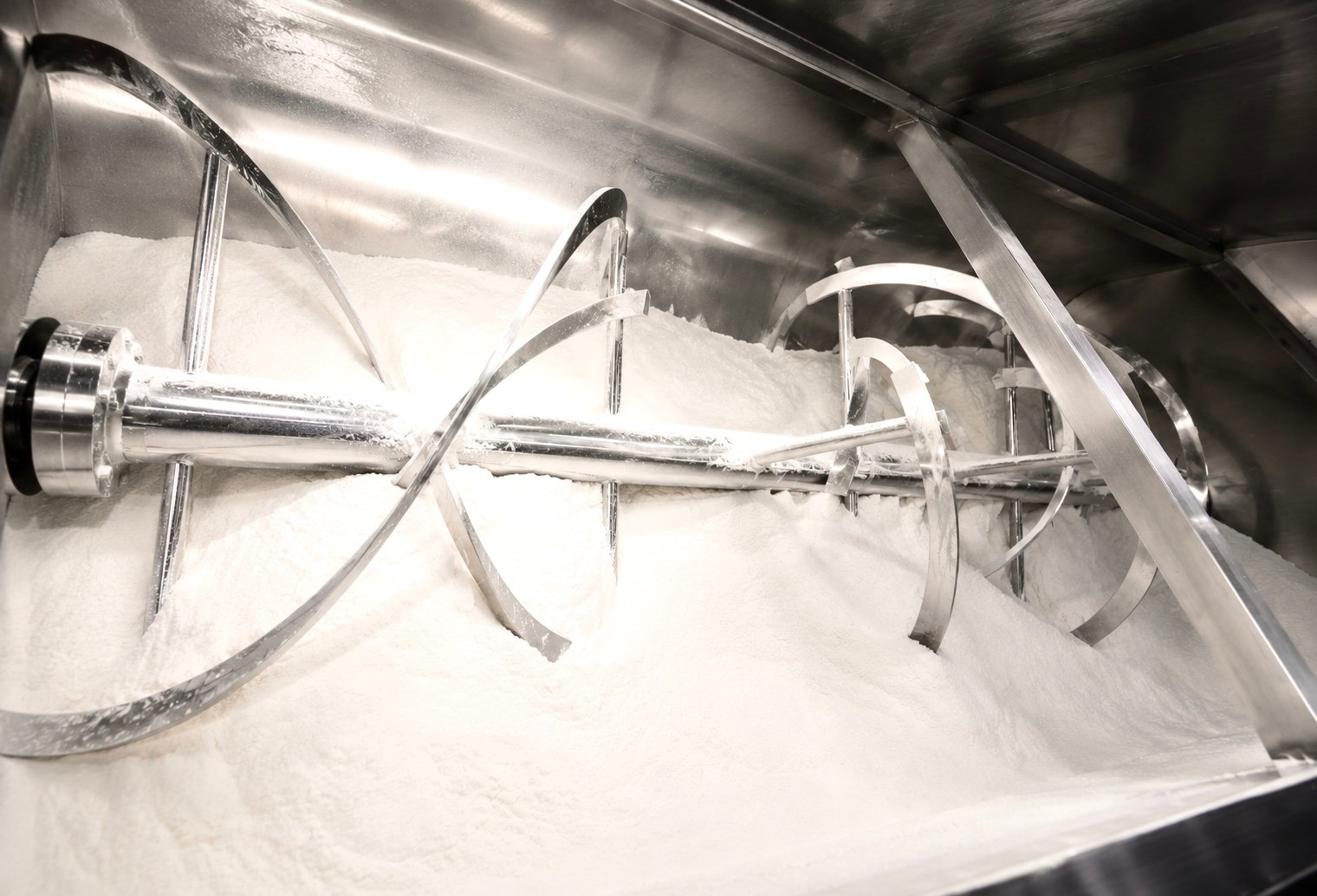
Dry blending combines two or more solid components, usually powders or granulars, into a uniform mix. Material moves through the blender in a controlled pattern so that every scoop pulled from the batch has the same composition as every other scoop. The end product is a free-flowing dry blend that can be packaged and shipped as is, or moved into a downstream step like screening or milling.
How liquid blending works at a high level
Liquid blending disperses or dissolves components into a liquid carrier. Depending on the recipe, the result may be a true solution, a dispersion where fine solids are suspended in liquid, or an emulsion of two liquids that would not naturally mix. The goal is not just uniformity at the end of the run, but stability, so the blend stays uniform in the container instead of separating on the shelf or in a tank.
Which material types and end goals suit each
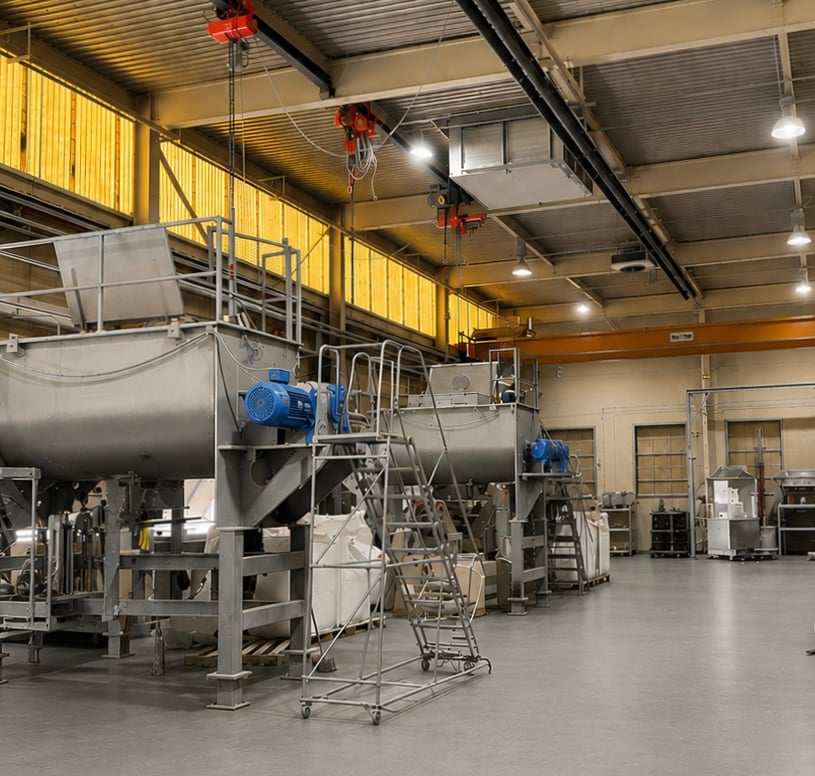
The simplest way to choose is to start with the physical state of your inputs and the format you need to ship in:
- Dry blending fits when all of your components are solids and the finished product is meant to be handled and used as a powder or granular. Typical goals are additive packages, dry-mix formulations, colorant premixes, and any product where uniform particle-to-particle distribution matters.
- Liquid blending fits when at least one component is a liquid, or when the end product needs to be poured, pumped, or metered. Typical goals are solutions, dispersions, suspensions, and finished liquid formulations that must stay stable through storage and transport.
If your product starts dry and ends up dosed into a liquid downstream by the end user, dry blending is often still the right choice. If you need a ready-to-use liquid off the line, liquid blending is the fit.
What actually drives batch consistency
Whichever process you use, a few factors decide whether every batch comes out on spec:
- Particle size match. In dry blends especially, components with very different particle sizes tend to segregate. Getting particle sizes into a similar range makes a much bigger difference than most people expect.
- Bulk density. Components with very different densities can also separate, with heavier particles migrating down and lighter ones riding on top. Matching or correcting for density improves homogeneity.
- Mixing time. Too short and the blend is not uniform. Too long and friable materials can degrade, or fines can start to segregate again in some equipment. The right time depends on the recipe and the equipment.
These factors are worth reviewing before you even start production, because they can be fixed in advance by adjusting the specification of your inputs.
If you want help matching your material and goals to the right process, our team offers toll blending and custom chemical blending services and can walk through the decision with you.
Need help with your chemical processing project?
Talk to our team today. Most projects start within 48 hours of receiving materials.