Why so much material arrives in super sacks
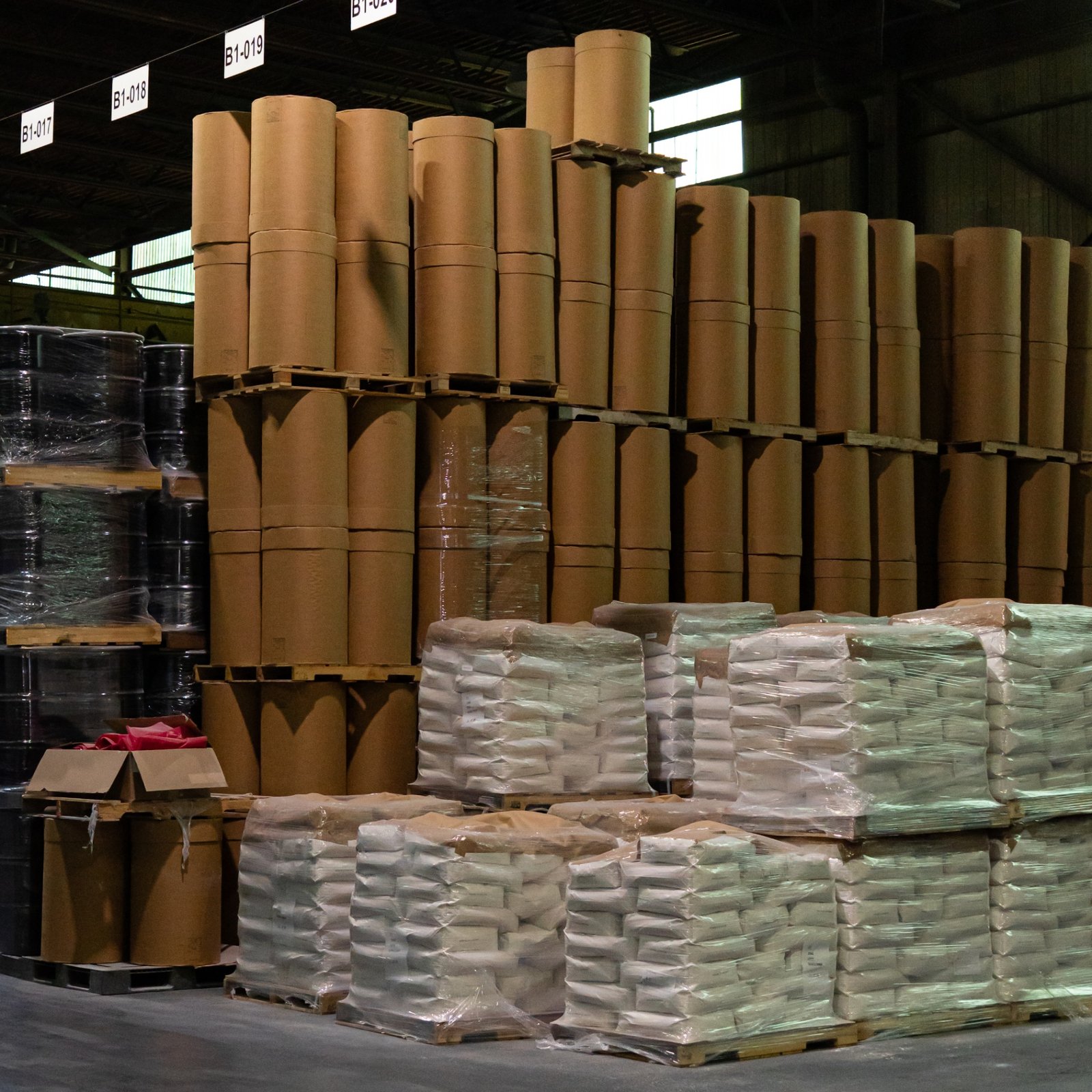
Super sacks, also called FIBCs or bulk bags, are the cheapest way to move one to two thousand pounds of dry product at a time. They stack, they ship on standard pallets, and one forklift driver can move a ton in a minute. That is why producers ship in them and why so many buyers end up with a warehouse full of material in a container nobody on the receiving end actually wants.
The end user wants 50 lb bags that one person can lift. The lab wants a 500 gram jar. The customer down the line wants 5 gallon pails with their label on them. Repackaging is the work that sits between those two realities, and most of it starts with a super sack hanging from a frame.
This walks through how that job runs on a typical day at our Elyria, Ohio facility, so you know what to expect and what to send when you ask for a quote.
Step 1: receiving and checking the material
Before anything is opened, the incoming sacks are matched to the paperwork: product name, lot numbers, count, and the safety data sheet. Torn liners, wet spots, and crushed pallets get photographed and noted, because damage that happened in transit is the shipper's problem and should be documented before work begins. Damaged packaging can be repaired and re-stretch-wrapped if the goal is simply to make the lot saleable again.
The sack type matters too. Our guide to FIBC types A, B, C, and D explains why a fine, dusty powder in a plain Type A bag needs more care around static than the same material in a grounded Type C bag.
Step 2: hanging and discharging the sack
A bulk bag unloading station is a steel frame with a hoist. The sack is lifted by its loops, the discharge spout on the bottom is untied into a hopper or directly over the filling point, and gravity does most of the work. For product that has packed down during shipping, operators work the sides of the bag to get it moving again.
Sometimes the material inside has set up into a solid block from humidity or long storage. When that happens, it can be delumped while it is still in the original sack, mechanically and without heat, before discharge. That step is covered in more depth in our article on rescuing clumped powder without repackaging it.
Step 3: filling the new containers
How the product gets into its new container depends on the size and the fill accuracy the customer needs.
Bags from roughly 25 to 50 lb go through a bagger. A valve bagger fills sealed valve bags through a small sleeve, which keeps dust down. An open-mouth bagger fills a bag that is then sewn or heat sealed across the top.
Pails, drums, and boxes are filled on a scale, either from the bagger's feed or by controlled transfer from the hopper.
Small units, from gram-level pre-weighs to a few pounds, are hand scooped on precision scales. Weights can be held to a tenth of a gram when the specification calls for it.
There is no minimum or maximum fill weight. One incoming super sack can become a mix of package sizes in a single pass, for example a pallet of 50 lb bags plus a case of sample jars. Our overview of chemical packaging options compares bags, drums, totes, and super sacks if you are still deciding what the final container should be.
Step 4: labeling, lot coding, and palletizing
Every filled container gets a label: your existing label, a label we print to your artwork, or a private label for a customer of yours. Lot codes carry through from the incoming sack so any finished unit can be traced back to its source. Pallets are built to your configuration, stretch-wrapped, and marked for shipping.
Step 5: paperwork and shipping
The job closes out with a count reconciliation: pounds in, pounds out, and any residue or loss accounted for. That reconciliation is what lets you invoice your own customers accurately and keep your inventory records honest. Finished goods ship from Elyria or are held for scheduled pickup.
What drives the price
Repackaging is quoted per job rather than from a price list, because the same pound of material can be easy or difficult depending on the details. The main cost drivers are:
The size of the final package. Hundreds of small pails or jars take far more labor per pound than a few dozen 50 lb bags.
Fill accuracy. Tight tolerances mean slower filling and more checking.
Dust and handling. Fine, dusty, or hazardous materials need more containment and cleanup.
Labeling. Printing and applying custom labels adds a step.
Material condition. Caked product that needs delumping first adds time.
What to send for a quote
A quote comes together quickly when the first email includes the product name and SDS, how it arrives (sack size and count), the target containers and fill weights, labeling requirements, and when you need it back. With that, a same-day quote is usually possible.
Our chemical repackaging service and our NBN Powder Packaging team handle exactly this work, from one pallet of sacks to recurring monthly campaigns.
Frequently asked questions
Can you repackage a super sack into 50 lb bags?
Yes. Super sacks are hung on an unloading station and discharged into a valve or open-mouth bagger, then each bag is weighed, sealed, labeled, and palletized. One sack can also be split into several package sizes in the same run.
What is the smallest package you can fill from a bulk bag?
Small units are hand scooped on precision scales, down to 1 gram pre-weigh bags, with weight accuracy to a tenth of a gram. There is no minimum or maximum fill weight.
How long does chemical repackaging take?
Standard turnaround is 3 to 5 days, and projects usually start within 48 hours of the material arriving. Rush options are available when a shipment cannot wait.
What if the powder in the super sack has turned into a solid block?
It can usually be delumped mechanically while still in the original sack, without adding heat, and then repackaged as normal. Finding out why it caked helps keep the next lot from doing the same thing.
Where can I get chemicals repackaged in Ohio?
US Chemical Services and its NBN Powder Packaging brand run a 100,000 sq ft facility at 955 Taylor St in Elyria, Ohio, west of Cleveland, and repackage material for customers across North America. Call (440) 529-8868.
What information do you need to quote a repackaging job?
Send the product name and SDS, how it arrives, the target containers and fill weights, labeling needs, and your deadline. With those details a same-day quote is usually possible.
Need help with your chemical processing project?
Talk to our team today. Most projects start within 48 hours of receiving materials.